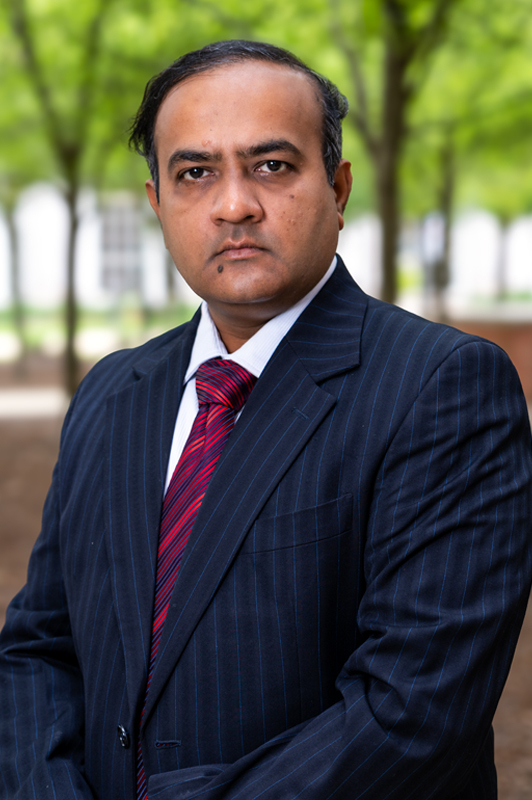
Gopikrishna Deshpande
Auburn University · Est. 2010

Gopikrishna
Deshpande

Professor, Department of Electrical and Computer Engineering & Auburn University Neuroimaging Center. Adjunct & visiting appointments at Auburn Psychology, NIMHANS Bangalore, and IIT Hyderabad.

📍 Auburn, Alabama gopi@auburn.edu ☎ 334-559-7223

My research lives at the intersection of signal processing, machine learning, and functional neuroimaging— building methods to read brain function from fMRI and EEG data, and applying them to questions in cognitive, social, clinical, and comparative neuroscience.

Over two decades, that work has spanned ultra-high-field 7T MRI of the human cortex, awake fMRI in working dogs, AI-driven diagnostic classification of brain disorders, and the neural underpinnings of meditation, decision-making, and trust.

By the numbers

Research at a glance

Updated April 2026 · Source: Google Scholar

7,794
Citations
53
h-index
117
i10-index
140+
Publications

Research focus

Explore research →

Methodological innovations

  • Functional Magnetic Resonance Imaging (fMRI)
  • Network modeling of brain function
  • Big data, pattern recognition & deep learning in neuroimaging
  • Multimodal imaging & data fusion (EEG/fMRI)
  • Ultra-high-field 7T MRI & sub-millimeter layer fMRI
  • Signal & image processing · Neurofeedback

Applied neuroscience

  • Sensory, motor, social & affective neuroscience
  • Consciousness & states of meditation
  • Autism, Alzheimer’s, PTSD, Parkinson’s, psychosis & depression
  • Neuroeconomics & neuromarketing
  • fMRI in awake working dogs
  • Complementary medicine, including yoga & meditation

Recent publications

All publications →
  1. 2026

    Neural insights into observational drawing: A longitudinal resting state functional connectivity study using 7T MRI

    A Safai, JS Katz, B Bondy, G Deshpande

    Brain and Cognition · vol. 192, pp. 106376

  2. 2025

    Effects of seasonal factors on brain function — a systematic review and future perspectives

    J Majumdar, D Rangaprakash, G Deshpande

    iScience · vol. 28(12), pp. 114066

  3. 2025

    VAE deep learning model with domain adaptation, transfer learning and harmonization for diagnostic classification from multi-site neuroimaging data

    G Deshpande, B Lu, PN Huynh, D Rangaprakash

    Frontiers in Neuroinformatics · vol. 19, pp. 1553035

  4. 2025

    Topology-assisted clustering of temporal fMRI brain networks with use-case in mitigating non-neural multi-site variability

    AR Shovon, S Kumar, G Deshpande

    IEEE Access · vol. 13, pp. 172259–172278

  5. 2025

    Non-invasive electrophysiological characterization of distinctive meditative states in a yogi during Samaadhi

    DN Dutt, GRG Rao, CR Ramaswamy, D Rangaprakash, G Deshpande

    International Journal of Yoga · vol. 18(3), pp. 321–341

  6. 2024

    Interpretable deep learning for neuroimaging-based diagnostic classification

    G Deshpande, J Masood, PN Huynh, TS Denney, MN Dretsch

    IEEE Access · vol. 12, pp. 55474–55490

Selected highlights

All honors →
Award · 2024

Outstanding Leadership Award

Recognized at the World Health 2.0 Conference in Las Vegas for extraordinary achievements in healthcare and wellness research.

Health 2.0 Conference
Media · NYT

Cover story on dog research

Awake fMRI in working dogs—training canines to lie still inside an MRI scanner—featured on the cover of The New York Times.

The New York Times
Patent · 2021

USA Patent 11013426

System and method of functional MRI of the neural system in conscious unrestrained dogs—issued 5 May 2021.

USPTO
Recognition · 2023

Senior Member, IEEE

Elevated to Senior Member grade in recognition of significant performance and substantial contributions in the field.

IEEE
Award · 2017

OHBM Merit Award

Organization for Human Brain Mapping recognized exceptional research with a Merit Award. ISMRM Magna/Summa Cum Laude awards 2013–2017.

OHBM & ISMRM
Funding · Active

$50M+ in External Grants

Lead or co-investigator on grants from NIH, NSF, DARPA, DoD, AFOSR, DHS, and NIMH—including the $49.9M DCSITE program.

Federal Agencies